El Campo de Sonora y El Tigre: A Story of Arrival, Belonging, and Resistance in the 1800s
The news of gold in Tuolumne County spread faster than wind through canyon. And when it reached the ears of Sonorans in northern Mexico, they came—not just with picks and pans, but with songs, stories, and a sense of place. They arrived before the rush. Before the maps. Before the names were changed. “After much research, I have concluded that there were few if any U.S. people yet settled… They most probably did not arrive until the spring of 1849.” wrote historian Stoddard[i]
History tells us that up to 10,000 Mexicans already lived in the region. They were miners, merchants, mothers, and civic leaders. Their presence was not an arrival—it was a continuation. The Sonorans camped first on Sonorita Hill, then moved closer to the stream that would become El Arroyo de Sonora. They built their lives in the verdant flat below Bald Mountain, where the water clattered toward Woods Creek, and a town would rise.
That town was “El Campo de Sonora”. And its heart was El Tigre.
[ii]Many of the early Latinos claimed land in the very heart of early Sonora along Arroyo de Sonora as Sonora Creek was called in the very first years of Sonora’s history. Here, families like the Cabezuts, the Lepes, and the Hernandez made their homes in Sonora. Don Pedro Lepe, born in Mexico in 1821, his wife Servula Olanchea and son Pompo where still in Sonora in 1860. Simon Cabezut, who arrived in the early days of 1849, was still in Sonora in 1890 according to Census records, a testament to stability in a time of upheaval. Candelaria Nunez- Superveille, died in Sonora in January 1900 and was remembered as one of Tuolumne County’s pioneer settlers (Mother Lode Magnet). These stories, carried in family memory, offer what official records often omit: the depth of Latino presence, persistence, and contribution.
Latinos also lived in many of the other residential areas of Sonora, including the western portion of Sonora, along the areas bordering Sonora Creek. Of the many who owned real estate, a fair number of deeds show that Latina women owned property in Sonora. The principles of the Mexican Constitution, which recognized a woman’s right to own property independently of her husband, shaped California’s early identity in ways often overlooked. Before Anglo legal systems took hold, these rights were visible in the deeds and businesses held by Latina women—testaments to autonomy in a time of upheaval. In a town swelling with transients and fortune-seekers, these women- built permanence. They raised children along Sonora Creek, and hosted gatherings in adobe homes. Their presence shaped the rhythm of daily life: the scent of pan dulce in the morning, the hum of conversation in the Sonora Restaurant, the quiet strength of women who knew the land as kin.
Every Sunday, miners from the most remote camps came to El Tigre seeking comfort. La Casa de Sonora served venison stews and bear steaks—meals that offered solace from the violence and disappointment of the mines. On the northeast corner of Main Street, near El Arroyo, stood La Tienda Mexicana[iii], owned by Emanuel Linoberg & Company. It was the most important mercantile in the Southern Mines, offering imported goods from Mexico: sarapes, saddles, reatas, panoche, sugar, chiles, beans, lace mantillas, silks, velvets, and flowered muslins. Behind its doors, a row of fandango houses pulsed with music, memory, and joy.
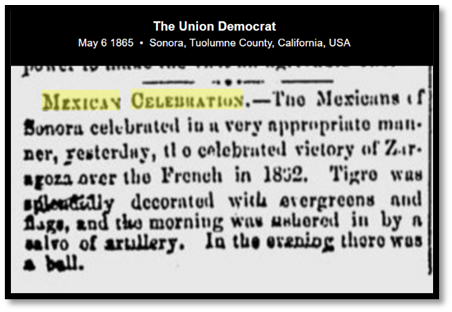
Traditions endured: Saturday morning rituals after Good Friday, songs passed down by elders, dances that defied erasure. During the 1860s and 1870s life was filled with many happy events and memories for families of the Latino community in Tuolumne County. Life revolved around family and church. There were times of boundless joy and happiness at weddings, births, and baptisms when the friends would gather for parties and celebrations. At times of sorrow the community joined together to support a bereaved family. The children attended school together. Music was enjoyed in the home and at parties and dances.[2] The Union Democrat published in 1865 “Mexican Celebration- The Mexicans of Sonora celebrated in a very appropriate manner yesterday, the victory of Zaragoza over the French in 1862. Tigre was splendidly decorated with evergreens and flags, and the morning was ushered in by a salvo of artillery. In the evening there was a ball.”
As gold grew scarce and immigrants flooded in, tensions rose. The Mexican American War had left wounds. Many of the sheriffs, and constables were veterans of the war with Mexico. Perkins, in his diary “Three Years in California”, marveled at the diversity of the region, noting “people of every nation… all mixing amicably and socially” , however, his account, one of the few of the era, did not gloss over the tensions that followed.
Alongside Mexican Californios and Sonorenses lived people from every corner of the world: Hawaiians, Chinese, Germans, French, English, Irish, Italians, and even English convicts transported from Australian prisons. They came seeking fortune or refuge, drawn by the promise of gold and the myth of a new beginning. Many of these immigrants arrived with little more than hope. Ireland had just endured its Great Famine. Germany, Italy, and France were reeling from revolutions in 1848. For many, arriving in the Americas was a last hope, a land of opportunity for those with nothing left to lose. It is easy to imagine the sounds of that place, the swirl of languages and accents, the clash and blend of customs, the quiet negotiations of meaning across cultures.
On May 1, 1851, Sonora was officially incorporated into the United States. But its story began long before that—with the Sonorenses, miners and families from the state of Sonora, Mexico, who founded the town and gave it its name. They were not newcomers—they were already home. Today, El Tigre asks to be remembered—not as a footnote, but as a foundation. It shaped Sonora’s beginnings. It holds stories and dreams of celebration, and survival. To honor El Tigre is to honor the people who contributed to built Sonora with their hands, their hearts, and their heritage.
By Mercedes Guerrero-Tune